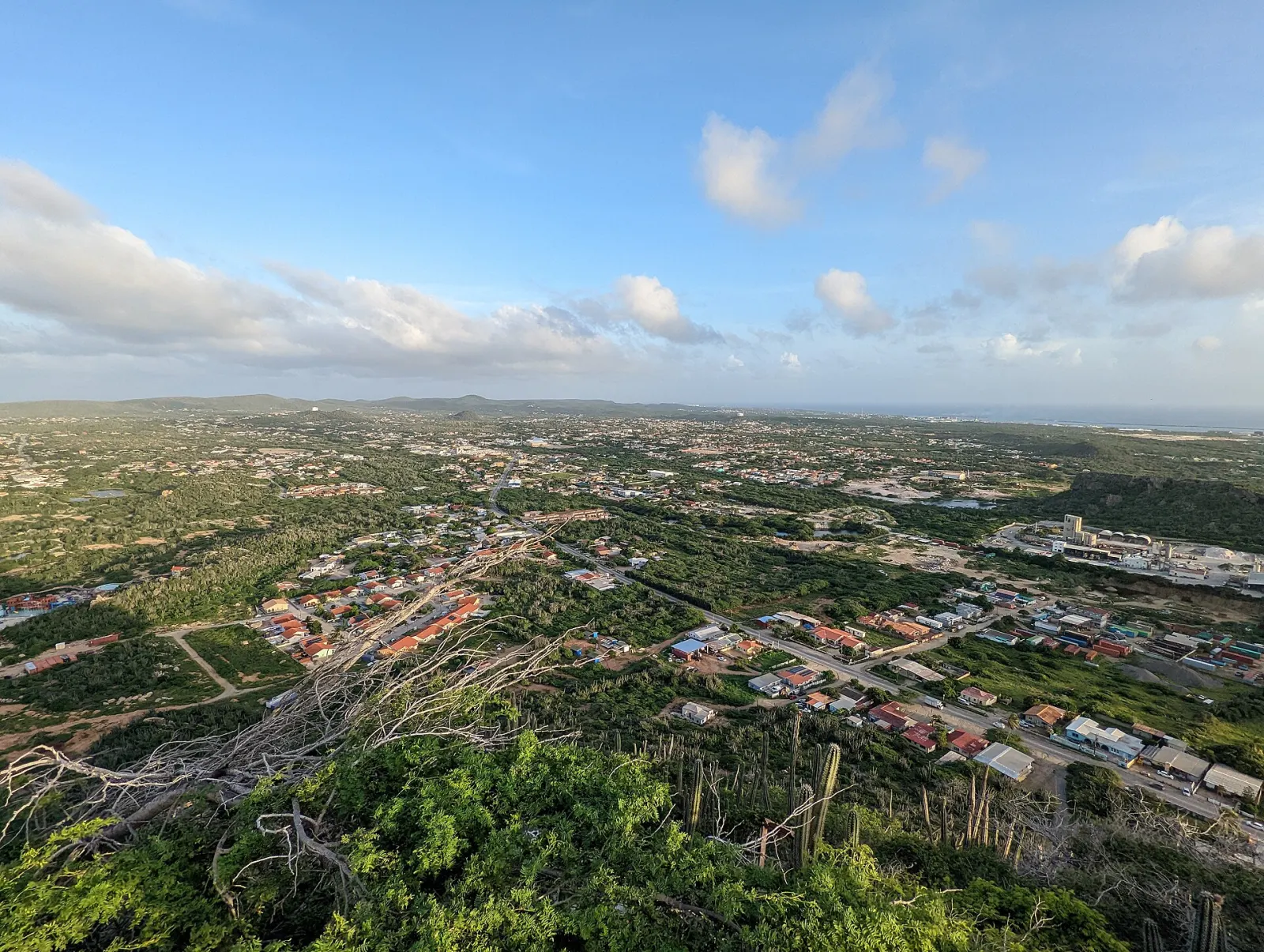
Best time to visit Aruba: weather month by month
Aruba is warm and dry all year. Here is what changes by month — rain, wind and prices — with the official 1991–2020 climate figures.
4 min read · Published 29 October 2026
Aruba is warm and dry all year: the Departamento Meteorologico Aruba's 1991–2020 normals give an average air temperature of 28.4 °C and just 451 mm of rain a year. The real differences between months are wind, a short rainy season from roughly October to December, and price — the high season runs from mid-December to mid-April. For the calmest, driest beach days with fewer crowds, many visitors aim for late April to June.
What is Aruba's climate like?
The island has a semi-arid hot climate (Köppen BSh), according to the meteorological department. Temperatures barely change through the year: the average daily maximum ranges from 30.3 °C in January to 33.2 °C in August and September, and nights rarely drop below 25 °C. Humidity stays around 76–79%. What keeps it comfortable is the wind: moderate to fresh easterly trade winds blow almost constantly, averaging about 27 km/h over the year.
Aruba weather month by month
Climatological normals 1991–2020 from the Departamento Meteorologico Aruba (wind converted from m/s to km/h):
| Month | Average °C | Avg max / min °C | Rain (mm) | Days with ≥ 1 mm | Average wind (km/h) |
|---|---|---|---|---|---|
| January | 27.0 | 30.3 / 24.8 | 44 | 10.8 | 26 |
| February | 27.1 | 30.6 / 24.8 | 20 | 4.5 | 28 |
| March | 27.4 | 31.1 / 25.3 | 10 | 2.0 | 28 |
| April | 28.2 | 31.9 / 26.0 | 9 | 1.5 | 29 |
| May | 28.7 | 32.0 / 26.7 | 14 | 1.7 | 30 |
| June | 29.0 | 32.5 / 26.9 | 17 | 2.8 | 32 |
| July | 28.9 | 32.4 / 26.7 | 31 | 4.1 | 30 |
| August | 29.5 | 33.2 / 27.2 | 20 | 3.1 | 28 |
| September | 29.6 | 33.2 / 27.3 | 43 | 3.3 | 24 |
| October | 29.1 | 32.4 / 26.7 | 77 | 7.3 | 22 |
| November | 28.4 | 31.5 / 26.0 | 87 | 9.6 | 20 |
| December | 27.5 | 30.7 / 25.3 | 80 | 11.0 | 24 |
| Year | 28.4 | 31.8 / 26.1 | 451 | 61.7 | 27 |
For the live forecast and sea conditions, see our Aruba weather page.
When is the rainy season in Aruba?
The meteorological department describes a rainy period from about September to January, and the Aruba Tourism Authority names October to December as the rainy season. The numbers agree: October, November and December bring 244 mm between them — more than half the annual total — and November is the wettest month with 87 mm. Even then, "rainy" is relative. December averages 11 days with at least 1 mm of rain, and the meteorological department notes that showers usually fall in the early morning hours. A day that starts with a shower often clears by mid-morning, which is when most people head to the beach anyway.
The flip side of the rainy months is the wind: October to December are the calmest months, with averages of 20–24 km/h. Without the breeze the heat feels stronger, and October is also the month with the most thunderstorm days (6.2 on average).
Does Aruba get hurricanes?
Rarely. The Caribbean hurricane season runs from June to November, but Aruba lies well south of the main Atlantic hurricane belt, and the UK government's travel advice notes that most hurricanes pass to the north of the island. The meteorological department puts it this way: only about once every 100 years is considerable damage caused by tropical cyclones passing just south of Aruba. Passing storms in the region can still bring clouds, rain or rough seas, so if you travel between June and November, follow forecasts from the Departamento Meteorologico Aruba and consider travel insurance that covers weather disruption.
When is the windiest time of year?
May to August. June has the strongest average wind (about 32 km/h), and the Aruba Tourism Authority calls May to October the windy season. That is good news for windsurfing and kitesurfing — the annual Aruba Hi-Winds event at Hadicurari Beach takes place in June or July — and it keeps the hottest months bearable. It also means blowing sand on open beaches and choppier water for small boats; for snorkelling, sheltered spots on the west and south coasts are a better bet on windy days.
When is high season, and when is it cheaper?
High season runs from mid-December to mid-April. Hotel prices are higher then and rooms need to be booked well in advance; the rest of the year is low season. The weather explains part of the demand — February to April are among the driest months, with only 1.5–4.5 rainy days — but so does winter in North America and Europe. If your dates are flexible:
- Late April to June: very dry (around 2 rainy days a month), breezy, and outside high season.
- July to September: the warmest months (average maximum 32–33 °C) and still fairly dry, though September's wind drops and it can feel hot.
- October to early December: the quietest wind and the most rain, but showers are short and the island is far less busy.
- Mid-December to mid-April: dry and pleasant, at the highest prices.
Is there a best month for wildlife and events?
Sea turtles nest on Aruba's beaches from March to September, and hatchlings emerge from May to November, according to the Aruba Tourism Authority. If you come across a nest or a nesting turtle, keep all lights off (including flash photography), watch from a distance and leave hatchlings to reach the sea on their own. Cultural highlights such as Carnival fall at different points in the year — check the events calendar against your dates.
What do visitors underestimate?
- The sun. Aruba lies at about 12.5° north. Even on a breezy, cloudy day the sun is strong; plan shade and reapply sunscreen.
- The sea on the north and east coast. At Boca Prins, for example, signs strongly advise visitors not to enter the water because of strong, ever-present undertows. Weather does not change that.
- Heat on hikes. In Arikok National Park start early — the Visitor Center opens at 8:00 — and carry plenty of water, especially from May to October.
See also Plan your trip and our guide to getting around Aruba.